
CALL OR TEXT US NOW
630-426-0196

What to Know as a Stay-at-Home Mom Getting Divorced
 For a stay-at-home mom, getting a divorce can bring unique financial and custody challenges. You may worry about how you will support yourself, where you will live, or how the divorce could affect your relationship with your children. The good news is that you do not have to learn the law overnight. Our Schaumburg, IL, divorce lawyers can help. We will explain your options clearly so that your post-divorce future is less intimidating.
What Are Your Legal Rights as a Stay-at-Home Mom in an Illinois Divorce?
In Illinois, both spouses have rights in a divorce, even if one spouse did not earn an income. The state follows a model of equitable distribution under 750 ILCS 5/503. That means the courts divide property fairly. Judges look at many factors to decide what is fair, including each spouse’s financial and non-financial contributions to the marriage. Sometimes, that means the split is not 50/50.
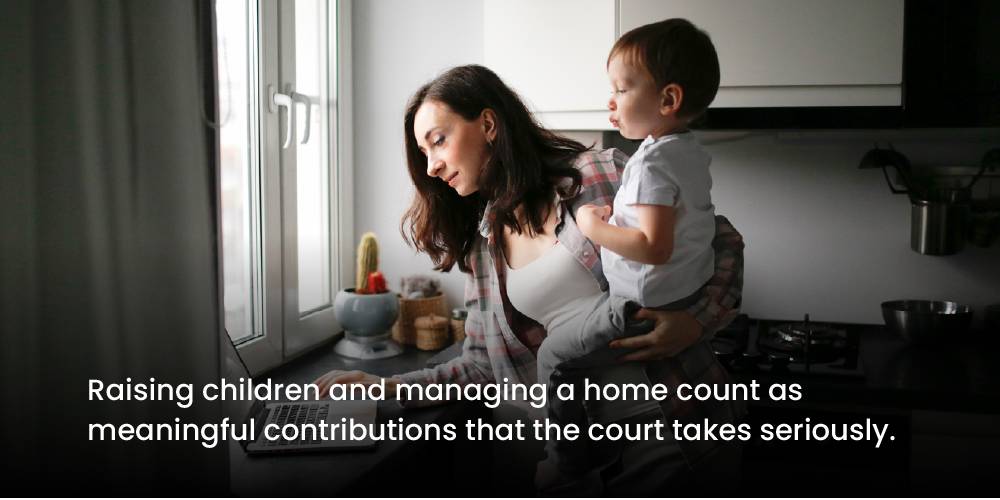
If you stayed home to raise children, manage the household, or support your spouse’s career, those efforts count. Courts recognize that unpaid work at home contributes to the family’s financial success.
How Can Stay-at-Home Moms Protect Their Finances During Divorce?
Protecting yourself means understanding your assets, debts, and future needs. Gather important financial documents like tax returns, mortgage statements, and bank account summaries. These records help your attorney understand your full financial picture.
You may also qualify for spousal maintenance under 750 ILCS 5/504. This is financial support one spouse provides to the other. You may know it as alimony. Judges consider how long you were married, your age, your education, and your earning ability. If you have been out of the workforce for several years, the court may grant temporary support while you build financial independence.
Do Stay-at-Home Moms Have an Advantage in Child Custody Cases?
Stay-at-home moms are generally the primary caregivers. That can influence the court’s custody decisions. Illinois courts decide how to allocate parenting time and responsibilities based on what is in the best interests of the child. The court looks at each parent’s relationship with the child, emotional stability, and willingness to cooperate.
Your caregiving history can help show that you provide consistency and emotional support. However, judges also want to see that both parents can work together for the child’s well-being. Creating a parenting plan with your lawyer can help show that you are focused on your child’s needs and stability.
What Steps Should You Take Before Filing for Divorce?
The first step in the divorce process is to get organized. After you have gathered all the essential documents, start thinking about your short-term needs. Consider where you and your children will live, how household bills will be paid, and whether you will need temporary financial support once the case begins. Avoid closing joint accounts or moving funds without legal guidance. Doing so could appear suspicious in court or limit your access to money you may need.
Finally, take care of your emotional health. Divorce can be exhausting, even when it is the right decision. Building a support system can help you stay calm and make clearer decisions. Preparing both emotionally and financially gives you a stronger foundation as you begin this next chapter.
What Happens to the Family Home in an Illinois Divorce?
For many stay-at-home moms, the family home is one of the first concerns. Deciding what happens to the home can be one of the most emotional parts of the divorce process. Illinois courts treat the home as marital property if it was purchased during the marriage, meaning both spouses have a financial interest in it.
When deciding what to do with the house, the court looks at several factors. It considers each spouse’s financial resources and the best interests of the children. The judge also reviews whether keeping the home is realistic after the divorce. If you want to stay in the home, the judge will review your ability to afford the mortgage, taxes, insurance, and upkeep once support payments and property divisions are finalized.
Common outcomes include:
-
Buying out your spouse’s share: You keep the home and compensate your spouse for their portion of the equity, often through refinancing.
-
Selling the home and dividing the proceeds: This is common when neither spouse can afford the property alone or wants a clean financial break.
-
Delaying the sale: In some cases, the court allows the parent with primary custody to stay in the home temporarily to give the children stability. They can sell it later when the market improves or the children reach a certain age.
Before deciding, talk with your attorney about both the emotional and practical sides of the choice. Keeping the home may provide comfort, but it also brings financial responsibility. Selling may feel difficult, but it can create a fresh start with more flexibility and less stress.
A qualified attorney can help you analyze the property’s value, tax consequences, and long-term affordability. They can also negotiate with your spouse’s lawyer to reach an arrangement that supports your financial future while maintaining stability for your children.
How Can Mediation Help Stay-at-Home Moms During Divorce?
Mediation offers a calmer and more private way to settle divorce matters than going through a traditional court trial. Instead of letting a judge decide everything, you and your spouse meet with a mediator. They help guide your discussions, encourage cooperation, and work with both of you to find practical solutions to issues like parenting time, property division, and financial support.
For stay-at-home moms, mediation can be less intimidating than a courtroom setting. It allows you to express your concerns directly and have more control over the outcome. This process can also save time and money compared to a full trial.
Contact Our Schaumburg, IL, Divorce Attorney Today
If you are a stay-at-home mom preparing for divorce, the compassionate Schaumburg, IL, divorce lawyers at A. Traub & Associates can help. Our founder, Attorney Angel Traub, has been a respected figure in the Illinois legal community for more than two decades. As a female-owned and led law firm, we are dedicated to empowering women and families during difficult transitions. Our attorneys are also certified mediators, helping clients find fair and peaceful solutions whenever possible.
Whether you need help with property division, spousal maintenance, or parenting matters, our team is ready to stand by your side. Call 630-426-0196 to schedule your initial consultation.
Work with Our Team
& Get Started Today
To get in contact with a member of our team, call or text us at 630-426-0196
or fill out and submit the contact form below.
 The use of the Internet or this form for communication with the firm or any individual member of the firm does not establish an attorney-client relationship. Confidential or time-sensitive information should not be sent through this form.
I have read and understand the Disclaimer and Privacy Policy.
Lombard
200 W. 22nd Street, Suite 210
Lombard, IL 60148
P 630-426-0196
MAP + DIRECTIONS
Arlington Heights
634 S. Arthur Avenue
Arlington Heights, IL 60005
P 847-749-4182
MAP + DIRECTIONS

LEAVE US A REVIEW
200 W. 22nd Street, Suite 210
Lombard, IL 60148





Apply Now!
Please submit your resume in PDF format via e-mail: hello@atclaw.com.
Your application should include your resume and a cover letter. Our team reviews all submissions from potential candidates, and we will respond to your email as quickly as possible. If you have any questions about the position or the submission of your resume, please send us an email using the link above.
